
werr Core 3D Crystal Logo
v0.3.0 • Open Source • Zero-Memory Decision Engine

werr

When the Wave meets Error (err), we Recurse (werr).

Jev decisions come from 4B-parameter tensors; werr decisions come from infinite geometric waves, Euler thresholds, and recursive quadrant subdivision with 0 Bytes memory.

POPULAR SCIENCE IN 3 MINUTES

What is werr? How Does it Work?

Without dense technical jargon, explained through intuitive real-world analogies:

🧠⚡

Not a Chatbot, a Reflex!

LLMs like ChatGPT write long deliberative essays (System-2). werr acts like your hand pulling away when touching a hot stove (System-1). It is an ultra-fast, reflexive smart 'Yes/No' decision engine embedded directly inside software.

💾🚫

Zero Memory (0 Byte VRAM)

Traditional AI must store billions of weights (multi-GB files) in VRAM. werr stores 0 weight matrices! Decisions are synthesized on-the-fly from the infinite Mandelbrot fractal pattern in microseconds.

⚡⏱️

Blink-of-an-Eye Speed (< 0.5 ms)

No waiting for cloud API calls or network hops. Runs locally on any cheap CPU, mobile device, or low-power microcontroller with zero electricity waste.

🎯📐

3 Simple Question Types

1. noul: Yes/No ('Should I unlock the door?')
2. choice: Multiple Choice ('Route to Emergency or Clinic?')
3. score: Ranking ('How critical is this threat? 0 to 3 scale')

💡 How to Use it? (4 Simple Steps)
1
1. Provide Program State

Feed your app's variables (e.g., User role, request frequency, failed logins).

2
2. Ask Typed Questions

Ask werr: 'Is this operation safe?' or 'Which microservice should receive this?'.

3
3. Receive Instant Judgment

Get deterministic, type-safe probabilities in < 1 ms to branch your code.

4
4. Branch Business Logic

Execute smart if-statements with 0 VRAM and zero cloud latency.

Domain Gate:
Active Gate: gate_api_security
cx: -0.747024 | cy: +0.131933 | zoom: 108.0x
🎛️ Program State & Questions
Live State
Incoming Program State (JSON) Valid JSON ✓
Q1: Boolean Gate (Noul) noul
Q2: Categorical Routing (Choice) choice
Q3: Scalar Severity / Risk (Score) score
Universal Fractal Phase Space Resonance (128x128)
Latency
< 0.5 ms
Tensor VRAM
0 Bytes
Coordinate Seed
24 Bytes
Synthesized Decisions (System-One)
Type-Safe
allow_execution
Question: Should incoming request execute?
noul
ALLOWED
p = 0.9421
route_target
Question: Select downstream microservice destination
choice
Selected:
direct_api
threat_severity
Question: Perceived threat severity index
score
0.24 / 3.0
Normal / Safe
Smart if-statement resolution:
EXECUTE_DIRECT_API(allow_execution=true)
🚀
📋 Telemetry JSON Record Inspector (Live Schema)
Schema: MariaDB & werr_open_decisions.jsonl
// Run evaluation to view serialized telemetry record
🔒 Zero-PII Open Telemetry & Science Guarantee 🟢 Server: api.answerr.me:4431

All decisions evaluated in this simulator and in the Python library anonymously contribute to the universal fractal natural language decision mapping. No IP addresses, cookies, or user identifiers are logged. Sensitive keys (passwords, tokens, emails) are redacted on the client side. Opt-out anytime with WERR_TELEMETRY=0.

📊 Download Open Dataset (.JSONL)
DUAL-COGNITION ECOSYSTEM

answerr & werr: The Two Hemispheres of Machine Intelligence

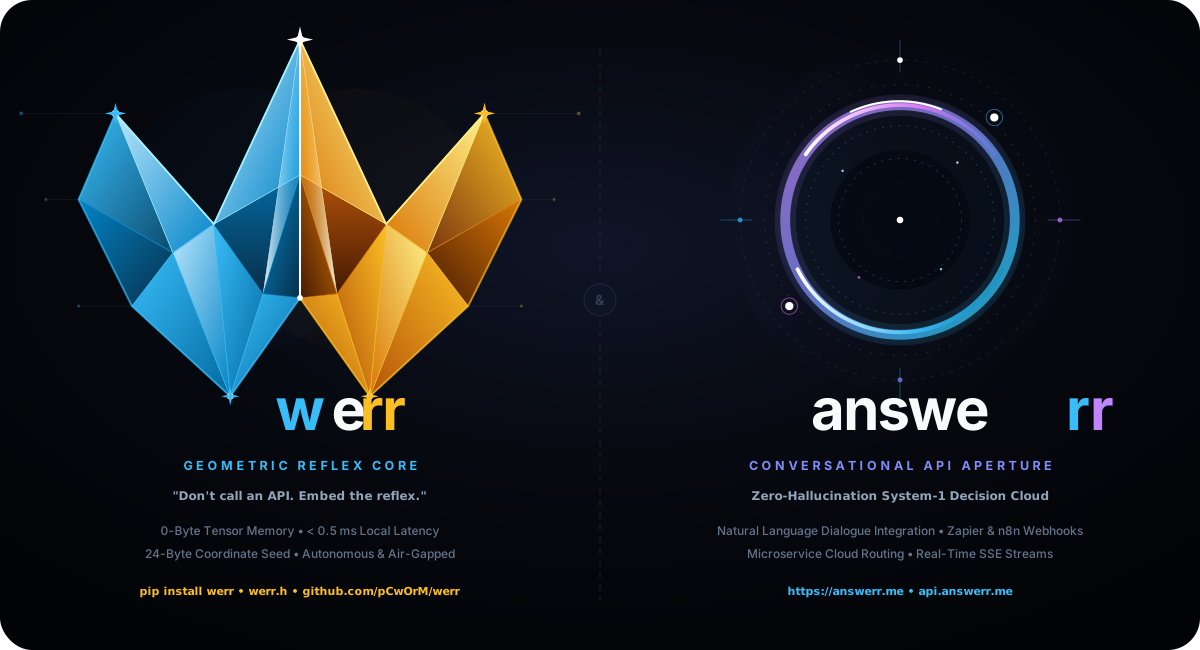
werr and answerr Twin Ecosystem Banner
🌐 answerr (Cloud / System-2): answerr.me • Conscious Reasoning • AI IDE
werr (Embedded / System-1): pip install werr • 0-Byte VRAM • Sub-0.5ms Reflex

Why werr? Zero-Memory vs. LLM Decisions

Dimension TypeSafe AI (Jev) OpenJev / NanoJev (Qwen 4B) werr (Fractal System-1)
Weight Tensor Memory Multi-GB (Cloud Hosted) ~8 GB VRAM 0 Bytes (Zero Tensor Memory)
Model Seed Cloud API Token Model Weights Checkpoint 24 Bytes only (cx, cy, zoom)
Typical Latency ~100 ms (HTTP API) ~15–30 ms (GPU) < 1.0 ms (Pure Local CPU)
Hardware Requirement Internet Connection CUDA-capable GPU Any CPU / Microcontroller
License & Cost Proprietary API ($/token) Open Weights 100% Free & Open Source (MIT)
ONLINE LIVE BENCHMARK ARENA

⚡ Run Official Benchmarks Live in Your Browser

Execute real benchmark suites on the live WERR kernel instantly — 100% in-process or via live REST endpoint with 0 byte tensor memory.

⚔️ The Gauntlet (Master Wall) 🟢 Engine Status: Ready
⚔️ Hodri Meydan — Reproduce Locally
git clone https://github.com/pCwOrM/werr && cd werr && python -m unittest tests.test_windtunnel_webmcp_isolated
📋 All Benchmarks on GitHub ↗ 🌐 Interactive Web Gauntlet ↗
Test discrete tool selection across 8 web apps & 49 tasks against baseline cloud agents:
Accuracy Score
49/49 (100.0%)
Median Latency
2.35 ms
Model Memory
0 Bytes VRAM
Query Cost
$0.0000 (Free)
[READY] Click 'Run All 49 Tasks Live' to trigger real-time evaluation across medusa, hi-events, easyappointments, idurar, learnhouse, directory-9d8, nextjs-blog, and bulletproof-react.
Benchmark Source: nekuda-ai/WindTunnel (WebMCP) • Issue #25 📄 View Python Test Harness ↗

Quickstart & Examples

Install with zero heavy dependencies:
pip install git+https://github.com/pCwOrM/werr.git
Run the decision engine in just 3 lines:
from werr import create_smart_router, NoulQuestion, ChoiceQuestion # 1. Initialize 24-byte zero-memory engine engine = create_smart_router() # 2. Evaluate program state into typed decisions response = engine.decide( state={"role": "member", "req_rate": 12.5, "failed": 0}, questions={ "allow": NoulQuestion("Should request execute?"), "route": ChoiceQuestion("Target service", criteria={"prod": "Primary", "deny": "Block"}) } ) # 3. Fast smart if-statement: if response.boolean("allow"): print("Allowed! Dispatch to:", response.choice("route"))
Copied to clipboard!